
- A holding electromagnet resists a sideways load only through friction, which is a small share of its rated pull.
- On a vertical face or a fast robot move, the load acts in shear, so the magnet needs several times more pull.
- A ledge or stop usually beats a bigger magnet.
Electromagnet shear force is the sideways load a holding electromagnet can resist before the part slides along its pole face. It comes only from friction, so it is typically a fifth or less of the rated pull. Parts on vertical faces and parts moved quickly by robots load the magnet in shear.
Why does a part slide off a magnet that holds it firmly?
Because the magnet pulls only at right angles to its face. It clamps the part against the pole face, and the only thing stopping the part moving sideways is friction between the two steel surfaces. Friction is a fraction of the clamping force, so a part that will not pull off can still slide off easily.
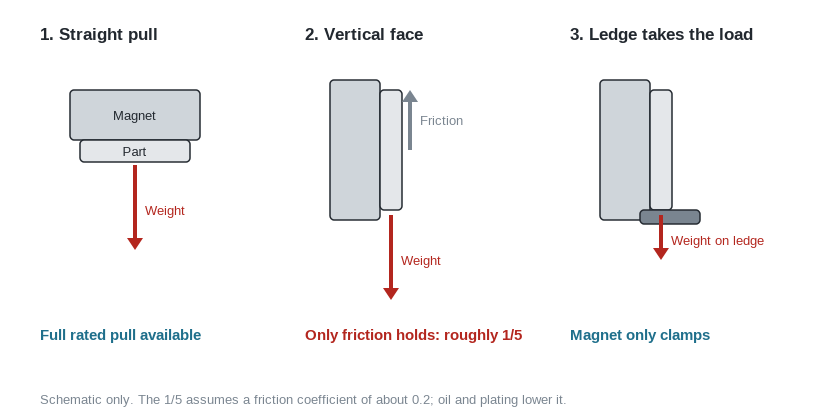
Rated holding force is measured as a straight pull off the face. Catalogs rarely state a shear figure for that reason. Magnet makers commonly put shear capacity at about 15% to 25% of the straight pull, which matches a friction coefficient of roughly 0.15 to 0.25 between the part and the pole face.
How much pull do you need when the load acts in shear?
Divide the sideways load by the friction coefficient, then apply your safety factor. With a coefficient of 0.2, a part needs five times as much pull to stop it sliding as to stop it pulling off. That is why a magnet sized for a horizontal fixture often fails when the same fixture is turned on its side. Turn the fixture and the sum changes.
As a round example, a 5kg part weighs about 49N. Hanging from a horizontal face it needs 49N of pull, about 100N with a safety factor of 2. Held on a vertical face, the same weight acts in shear, so it needs 49N divided by 0.2, about 245N, and about 490N with the same safety factor.
The basic pull formula, the plate thickness and air gap effects, and the safety factors for static and moving loads are set out in the pull formula and safety factors. Size the magnet on the shear figure whenever any part of the load acts along the face. Never on the pull alone.
How does robot acceleration turn into shear load?
Every time a robot or gantry speeds up, slows down or turns, the part’s inertia pushes it sideways across the gripper face. That inertial force is mass times acceleration, and it acts in shear. On a fast pick-and-place move it can be larger than the part’s weight, even when the gripper face points straight down.
Take a 2kg blank hanging below a horizontal gripper face, moved sideways at 10 m/s², roughly 1g. Its weight is about 20N in straight pull. The sideways inertia is another 20N in shear, which at a coefficient of 0.2 needs about 100N of pull. A simple, conservative sum is 120N, about 360N with a safety factor of 3 for moving loads.
Speed does not matter here. Peak acceleration does, and it is set by the hardest start or stop in the whole cycle, which is often an emergency stop rather than a normal move. Ask the robot integrator for the peak value of the move, including emergency stops, which decelerate harder than normal moves. Gripper plates sized for robot acceleration are specified from that peak, the part and the payload left for the tool. Turning that load into a magnet count, layout and gripper weight is the subject of sizing a magnetic gripper for a robot.
Why does the friction coefficient change on the line?
Because it depends on the two surfaces, and production surfaces change. Clean, dry, bare steel on a ground pole face grips best. Drawing oil, coolant, plating, paint and polished faces all let the part slide more easily. A coefficient that holds on the bench can drop sharply once oily blanks arrive. Oil is the usual culprit. A blank that arrives straight from the press with drawing oil on it, onto a smooth plated pole face, can slide at a fraction of the force a clean blank needed on the bench the week before.
Coatings cost twice. First, they lower the friction coefficient, and they also add an air gap that lowers the pull the friction depends on. A painted or zinc-plated part on a vertical face is the hardest case a holding electromagnet meets. Size it on the lowest coefficient you expect, not the one measured on clean steel.
What is the cheapest way to stop a part sliding?
Take the shear load mechanically and let the magnet only clamp. A ledge under a part on a vertical face, a stop at the end of a gripper, or a locating pin through a hole carries the sideways load directly. The magnet then works in straight pull, where it is strongest, and a smaller size often does the job.

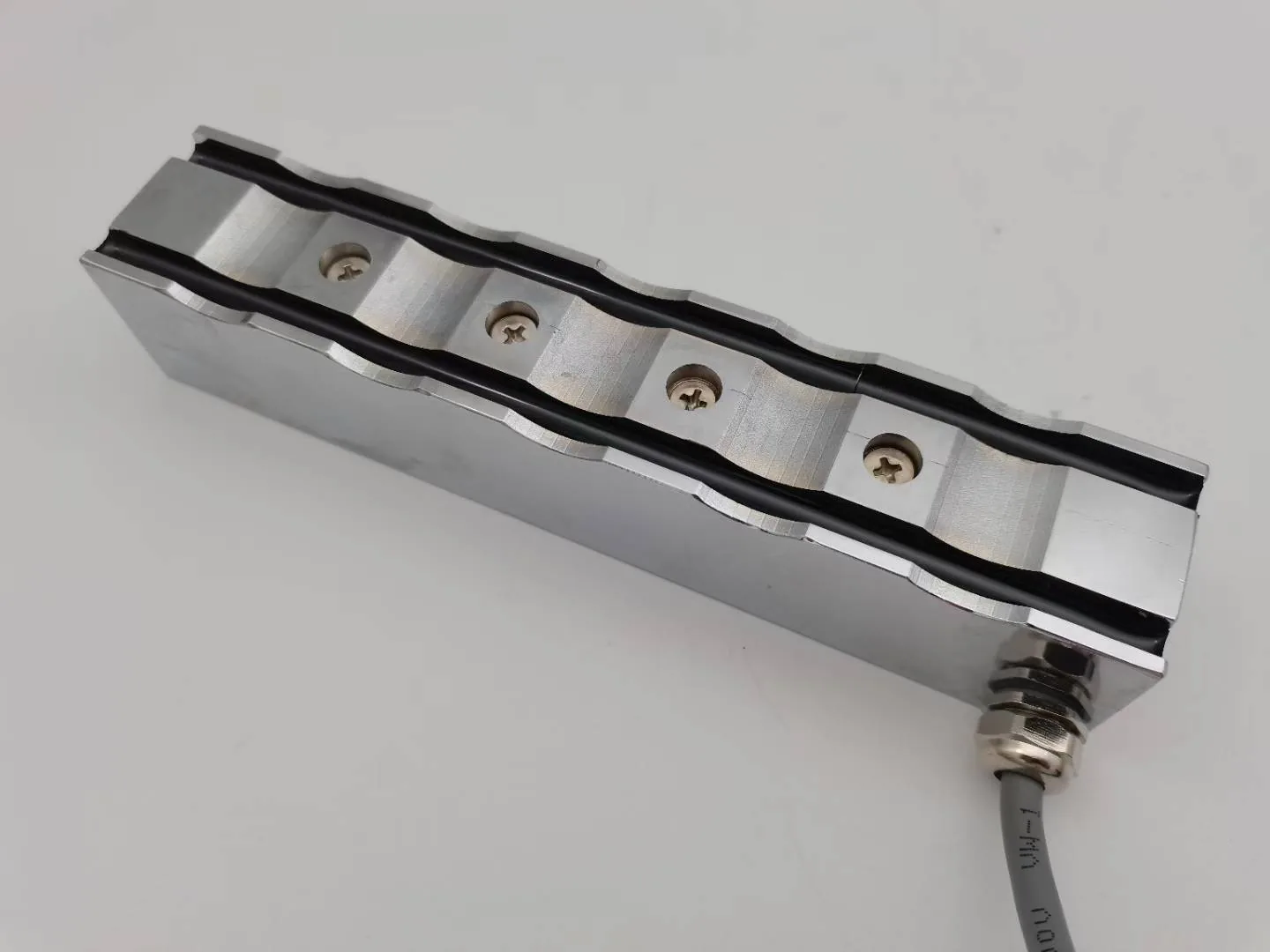
Shaped faces help too. A V-groove locates bar, tube and pins so the groove walls resist rolling and sliding, as on rectangular magnets with V-groove pole faces. Where a stop is impossible, more pole area or a second magnet spaced along the part raises the friction available.
Friction pads are a trade-off. A rubber or polymer pad on the pole face raises the friction coefficient, but the pad itself is an air gap and cuts the pull. Whether the net shear capacity goes up depends on the pad thickness and the magnet, so test a padded sample on the real part before relying on it.
Can a holding electromagnet be the only thing that keeps a gate shut?
No, not where anyone could be hurt if it lets go. A holding electromagnet releases the moment its current stops, and a holding force rating says nothing about how it fails. On gates, guards and anything that carries people, fit independent mechanical retention that holds on its own, and treat the magnet as an aid.
Current can stop for many reasons: a supply fault, a broken lead, an emergency stop, a controller error. A horizontal gate also loads the magnet in shear, where it holds only a fraction of its rated pull. A catalog figure is a design value, not a safety rating, and Lodegrip supplies holding electromagnets as components, not as certified safety devices.
The safety function belongs to the machine builder, designed and validated under the standard that applies, such as ISO 13849 for machinery control systems or the ride or machine standard for the product. The magnet can still hold the gate in position in normal running, sized for the real shear load with margin and tested in that direction. Plan the supply side for loss of power as well, as described under what happens when the magnet supply fails.
How do you find why parts are slipping on the line?
Work from the cheapest check upward. Confirm the direction of the load first, because a part that slides is almost always loaded in shear. Then check the surfaces, the pull itself, and the motion. Most slipping parts turn out to have a new coating, an oily batch or a faster robot program behind them.
- Is the load acting along the face: a vertical mounting, a tilted fixture or a sideways move?
- Have the parts changed: oil, coating, thinner steel?
- Is the magnet still pulling its full force: voltage at the coil, a warm coil, a dirty pole face?
- Has the motion changed: higher speed, harder stops, a new emergency stop setting?
- Has a stop or ledge worn, bent or gone?
If the pull itself has dropped, the checks for a holding electromagnet losing force find the cause. If the pull is fine and the parts slide anyway, the answer is a stop, a shaped face or a magnet sized for shear, not more voltage.
How we checked this
This guide draws on published engineering practice for magnetic holding and on what this factory builds: round, rectangular, V-groove and multi-pole DC holding electromagnets and gripper plates. The 15% to 25% shear range is the figure magnet makers commonly publish, and the examples are round arithmetic with a coefficient of 0.2. We did not measure friction coefficients, shear capacity or pad performance for this article, so no figure here is a Lodegrip test result. Written 5 October 2026.
Electromagnet shear force FAQ
What is the difference between holding force and shear force?
Holding force is the pull needed to lift a part straight off the face. Shear force is the sideways load needed to slide it along the face. Shear depends on friction, so it is usually a fifth or less of the holding force.
Is shear force ever listed on electromagnet datasheets?
Rarely. Ratings are measured as a straight pull. If a sideways load matters, work it out from the pull and a conservative friction coefficient, or ask for a test on your real part and surface.
Does a bigger magnet fix sliding?
It helps, but slowly, because you need about five times the pull for each unit of sideways load. A ledge, stop or locating pin that takes the shear directly is usually cheaper and more reliable.
Do rubber pads stop parts sliding on a magnet?
They raise friction but add an air gap, which lowers the pull. The net effect depends on pad thickness and the magnet, so test a padded sample before using it in production.
How do I account for robot acceleration?
Multiply the part mass by the peak acceleration of the move, including emergency stops, and treat that force as shear. Add it to the weight in its own direction, then apply a safety factor of at least 3 for moving loads.
Can a holding electromagnet be mounted on a vertical face?
Yes, if it is sized for shear or the part sits on a ledge. Tell us the part weight, its surface and whether a stop is possible, and the magnet is sized for the vertical load rather than the catalog pull.
Parts sliding on a vertical fixture or a fast robot?
Tell us the part weight and surface, the mounting angle, and the peak acceleration of the move. Send the load direction and motion and an engineer will size the magnet for shear or suggest a stop that lets a smaller one do the job.
Foshan factory since 1992 · ISO 9001 certified factory · MOQ 50 pcs · samples in seven days