
Round and ring holding electromagnets, 12V and 24V DC
- Diameters from about 10mm to 200mm, rated from a few newtons to about 9,500N, on 24V or 36V DC for the larger sizes.
- Ring and arc versions for bores, tubes and curved parts.
- Epoxy-potted coils, Class B insulation, zinc or nickel plating.
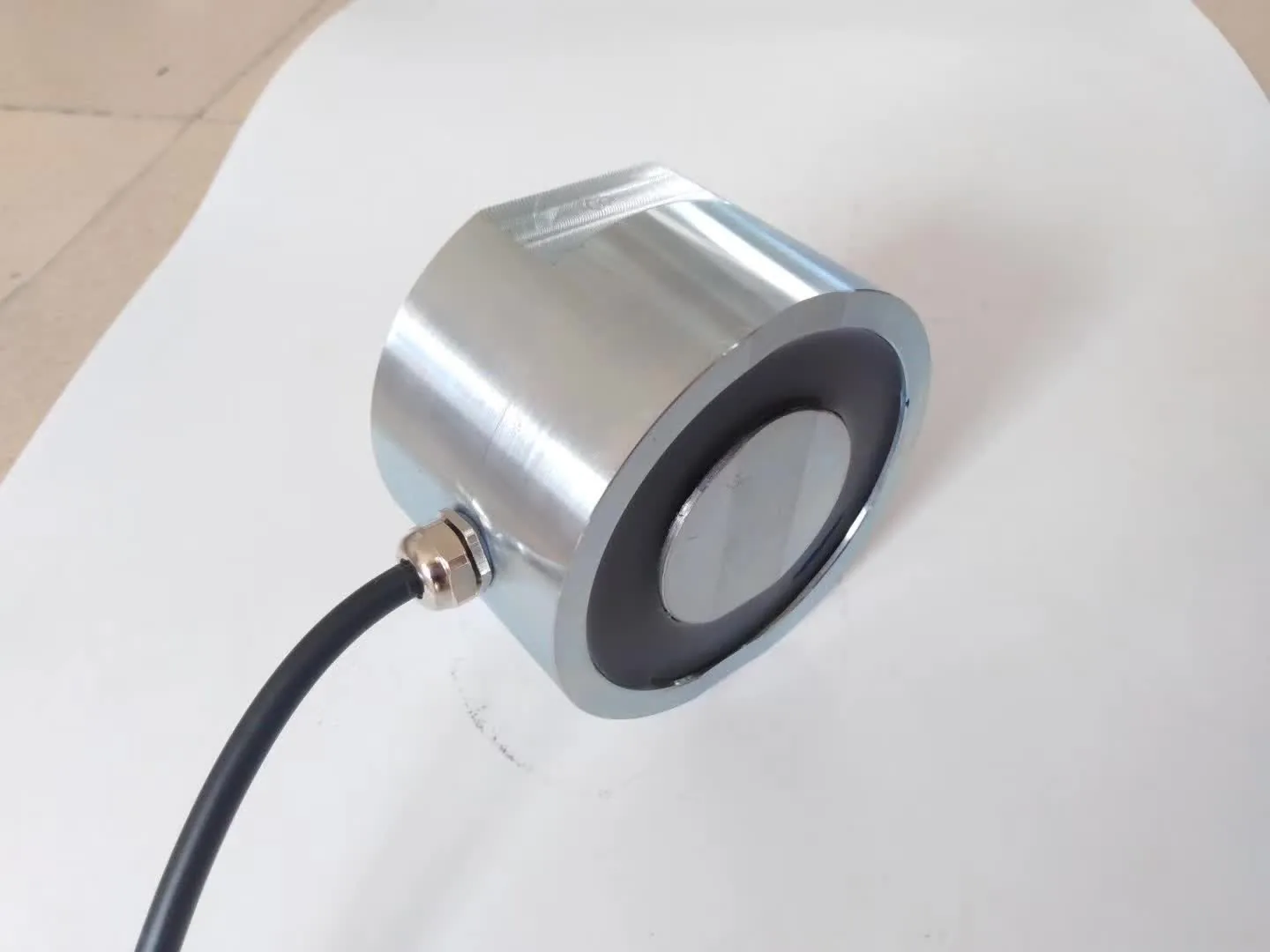
A round electromagnet is a DC holding magnet with a coil wound around a center pole inside a cylindrical steel housing. When 12V or 24V DC is applied, the center pole and outer rim form a closed magnetic circuit through a flat steel part, clamping it until the current is switched off.

Round units are the most common shape in our full holding electromagnet range, because one center thread makes them quick to fit.
How is a round holding electromagnet built?
A round holding electromagnet has four parts: a steel pot, a copper coil on the center pole, epoxy potting that locks the coil in place, and a lead wire or connector. The ring-shaped outer rim and the center pole are the two pole faces that touch the steel part.
The flux path is short and symmetrical. That gives a round unit high force for its size on a flat face, and the zinc or nickel plated housing resists corrosion on the shop floor.


What are the round electromagnet specifications?
Standard round holding electromagnets run from 10mm to 180mm in diameter. Small sizes rated at a few newtons suit light positioning work, mid sizes around 50mm hold several hundred newtons, and units above about 75mm diameter reach thousands of newtons, usually on a 24V DC supply.
| Diameter band (mm) | Holding force range (N) | Voltage (V DC) | Typical power (W) | Mounting thread |
|---|---|---|---|---|
| Up to 24 | Under 40 | 3.3 to 24 | Under 5 | M2 to M4 |
| 25 to 45 | 50 to 350 | 12 or 24 | 2 to 10 | M4 to M6 |
| 46 to 75 | 450 to 1,300 | 12 or 24 | 5 to 20 | M6 to M8 |
| 76 to 130 | 1,000 to 4,500 | 24 or 36 | 10 to 90 | M8 to M10 |
| Over 130 | 4,500 to 9,500 | 24 or 36 | 30 to 160 | M10 to M12 |
Catalog ratings for standard designs in each size band, at rated voltage on S235 low-carbon steel 5mm to 25mm thick (thicker plate for larger sizes), ground surface, zero air gap, full pole contact, coil at 20°C. The low end of each force range is a continuous 100% ED rating on the smallest size in the band; the high end is a 50% ED rating on the largest, which needs equal off time. Coated, curved, thin or stainless parts hold less. Confirm the force on a sample of your own part. Standard magnets are fully potted and sealed to IP65. 1N is about 0.225lbf.
Need exact dimensions, force and a STEP file for one size? Send your application to request the full datasheet, and we reply with the datasheet and 3D model.
Each power range covers both duty cycles across the band. The smallest sizes are also made for 3.3V to 6V DC. The guide on how holding force is rated explains why a thin or painted part holds less than this table shows.
Where are round electromagnets used?
Round electromagnets clamp flat steel parts in machining and welding fixtures, hold blanks on pick-and-place heads, position parts on assembly lines and sort ferrous items on conveyors. They also serve in textile machines and safety mechanisms where a part must hold on command and drop when power stops.
Long or narrow parts are better served by rectangular and square electromagnets, which spread the force along the part. Wide sheet usually needs a multi-pole electromagnetic gripper plate rather than a row of round units.
How do you mount a round electromagnet?
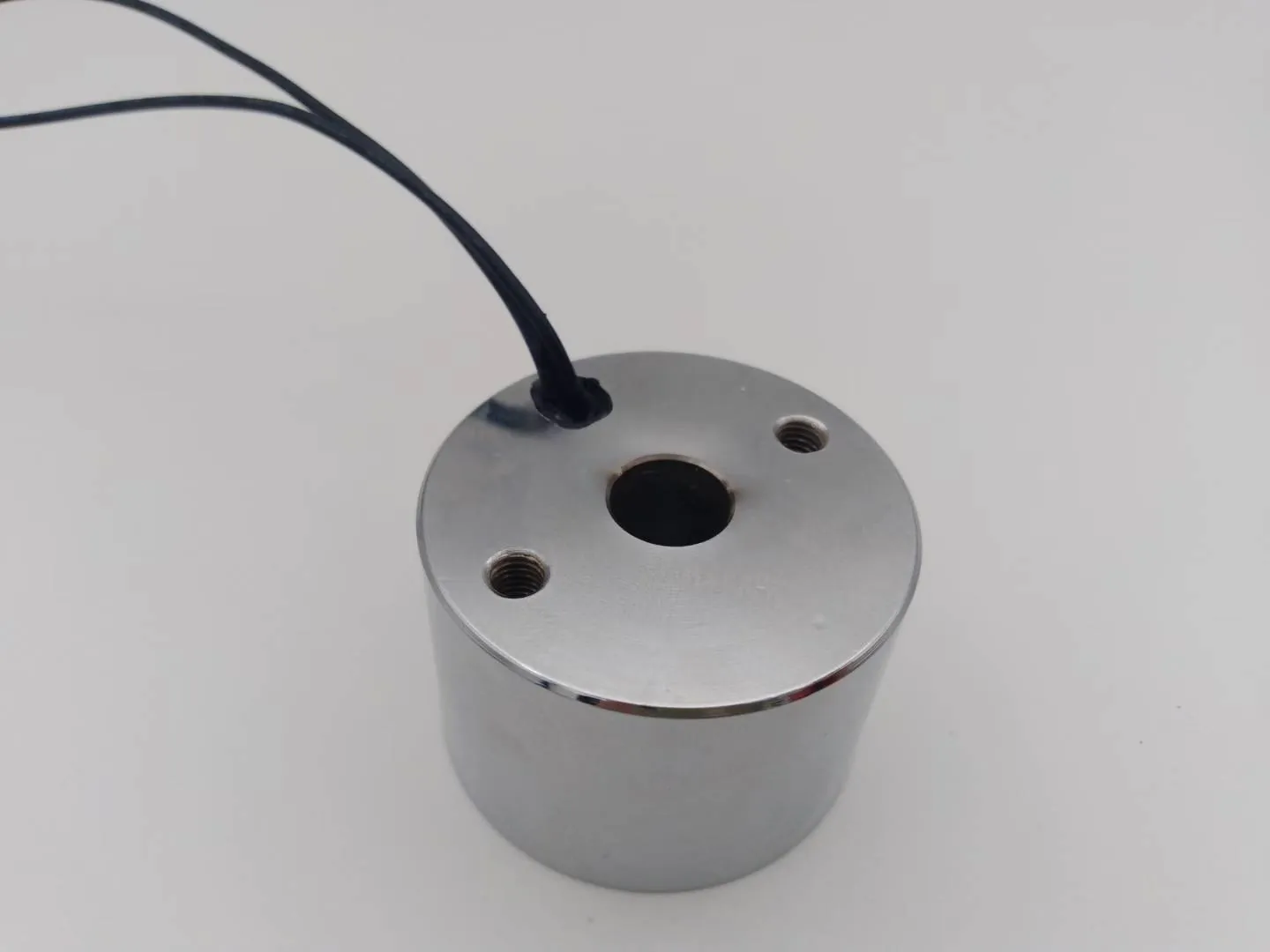
Most round electromagnets fix through threaded holes in the back face, from M2 on small sizes to M12 on large ones. Some have a center through hole or four holes around the pole, like the flat disc types shown above. The lead wire or cable gland exits from the back or side.
Keep the pole face flush with, or slightly proud of, the fixture surface. The part should touch the magnet before it touches the fixture.
What are ring and arc holding electromagnets?
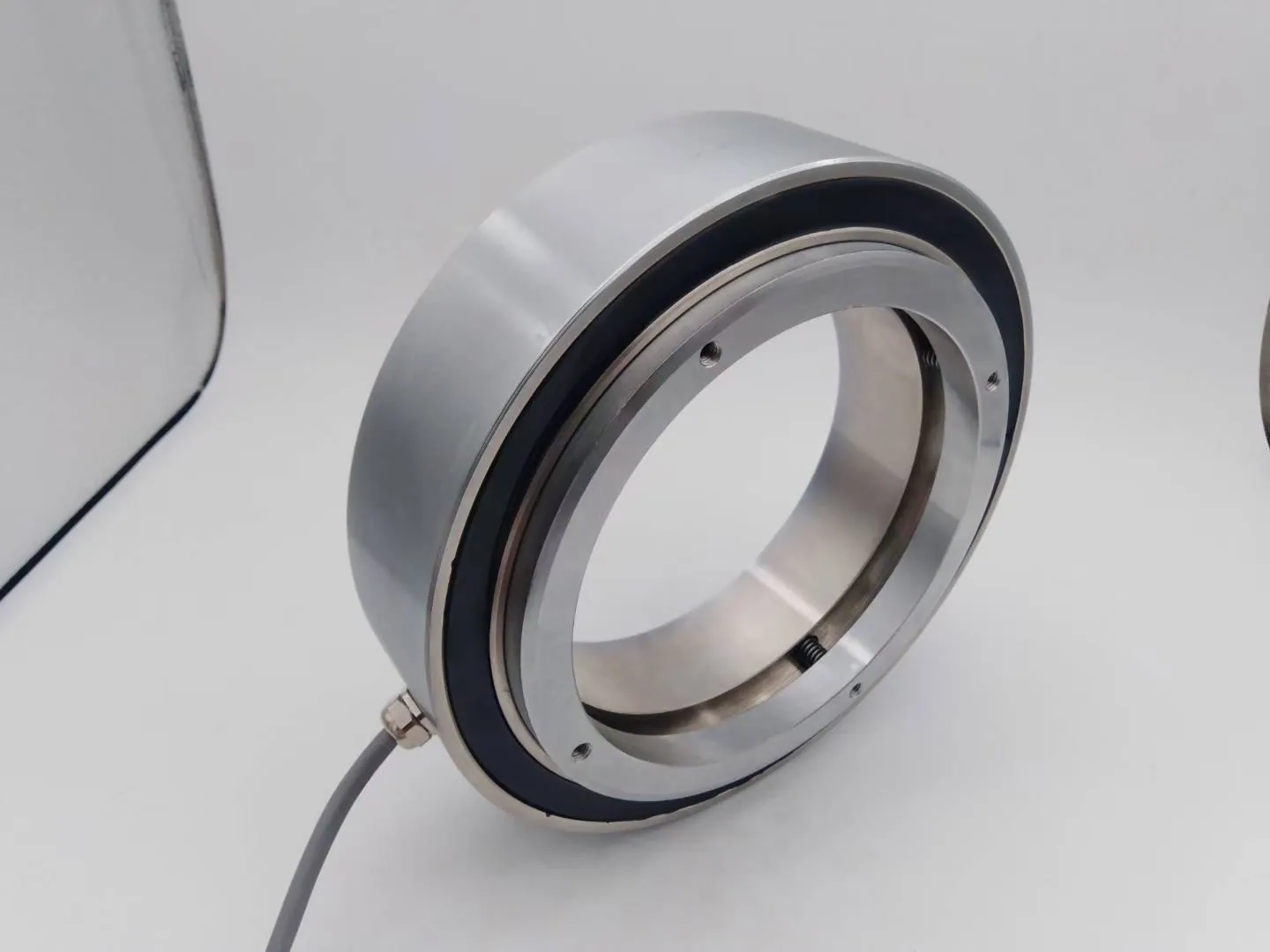
A ring holding electromagnet is a round unit with a large center bore, so a shaft, bolt or sensor can pass through it. An arc electromagnet is a curved segment whose pole face follows a round part; two or more segments can form a split ring around a tube, drum or roller.
Ring units keep the same pot construction, with the bore running through the center pole. Arc segments are built to the radius on your drawing, so there is no standard arc size list.
| Outer diameter band (mm) | Holding force range (N) | Voltage (V DC) | Typical power (W) | Mounting thread |
|---|---|---|---|---|
| 60 to 90 | Up to 350 | 24 | 10 to 30 | M5 |
| Over 90 | 1,500 to 2,800 | 12, 24 or 36 | 10 to 45 | M6 to M8 |
Catalog ratings for standard ring designs in each size band, at rated voltage on S235 low-carbon steel 10mm to 15mm thick, ground surface, zero air gap, full contact around the bore, coil at 20°C. The smaller ring band is rated at 50% ED only; in the larger band the low end is a 100% ED rating and the high end a 50% ED rating. Coated, curved or stainless parts hold less.
Ring bores and heights vary by design, so ask for the ring datasheet with your shaft or sensor size, and we send the drawing and STEP file.




What can be customized on a round electromagnet?
Diameter, height, pole shape, voltage, force, duty cycle, mounting threads, lead length and connector can all be changed from 50 pieces. Common additions are a spring-loaded ejector pin that pushes the part off against residual magnetism, a matching armature plate, a cable gland for wet or dusty areas, and high-temperature versions with Class H insulation for hot parts.
Samples take seven days and production about 25 days. The factory test and assembly process covers the type tests each new design goes through, including holding force against steel thickness, temperature rise and life.
Round electromagnet FAQ
Is a circular electromagnet the same as a round electromagnet?
Yes. Both names describe the same pot-shaped DC holding magnet with a center pole and an outer rim.
Can a round electromagnet hold a curved or painted part?
It holds less. Paint and curvature both open an air gap between the pole face and the steel. For round parts, an arc segment or a V-groove face works better.
Does a round electromagnet get hot?
The coil warms while it is powered. Keep within the rated duty cycle so the coil stays below the 130°C limit of its Class B insulation.
Which voltages are available?
Standard coils run on 12V or 24V DC. Small sizes can run on 3.3V to 6V DC, large sizes on 24V or 36V DC, and other DC voltages are made on request.
What is the minimum order for round electromagnets?
MOQ is 50 pcs per design. Samples take seven days and production about 25 days.
How much does a round electromagnet cost?
Price depends on the diameter and holding force, the coil voltage and duty cycle, the order quantity, and any custom pole face, housing, cable or connector. We do not publish a price list because most orders are built to the drawing. Send your requirements and we quote, usually within one business day.
What do we need to quote a round electromagnet?
Send the diameter and height limits, the holding force you need, the part material and thickness, your supply voltage, the duty cycle and the yearly quantity. A drawing of the fixture helps. Lodegrip replies with a suggested size, a sample plan and a quote for 50 pieces or more. Ask for the 2D drawing or 3D STEP file of any standard size, and we send it with the quote.
Foshan factory since 1992 · ISO 9001 certified factory · MOQ 50 pcs · samples in seven days