
- The return spring works against the coil on the way in and for it on the way out.
- It must be strong enough to beat friction and weight at the open end, and weak enough to leave the coil margin at the start of the stroke.
- A softer spring with some preload usually fits that window better than a stiff one.
A push-pull solenoid return spring has to sit inside a window. At the open position it must push harder than friction and any weight it lifts, or the plunger will not come back. At every point of the stroke it must stay below the coil force, or the plunger will not pull in.
What does the return spring actually do?
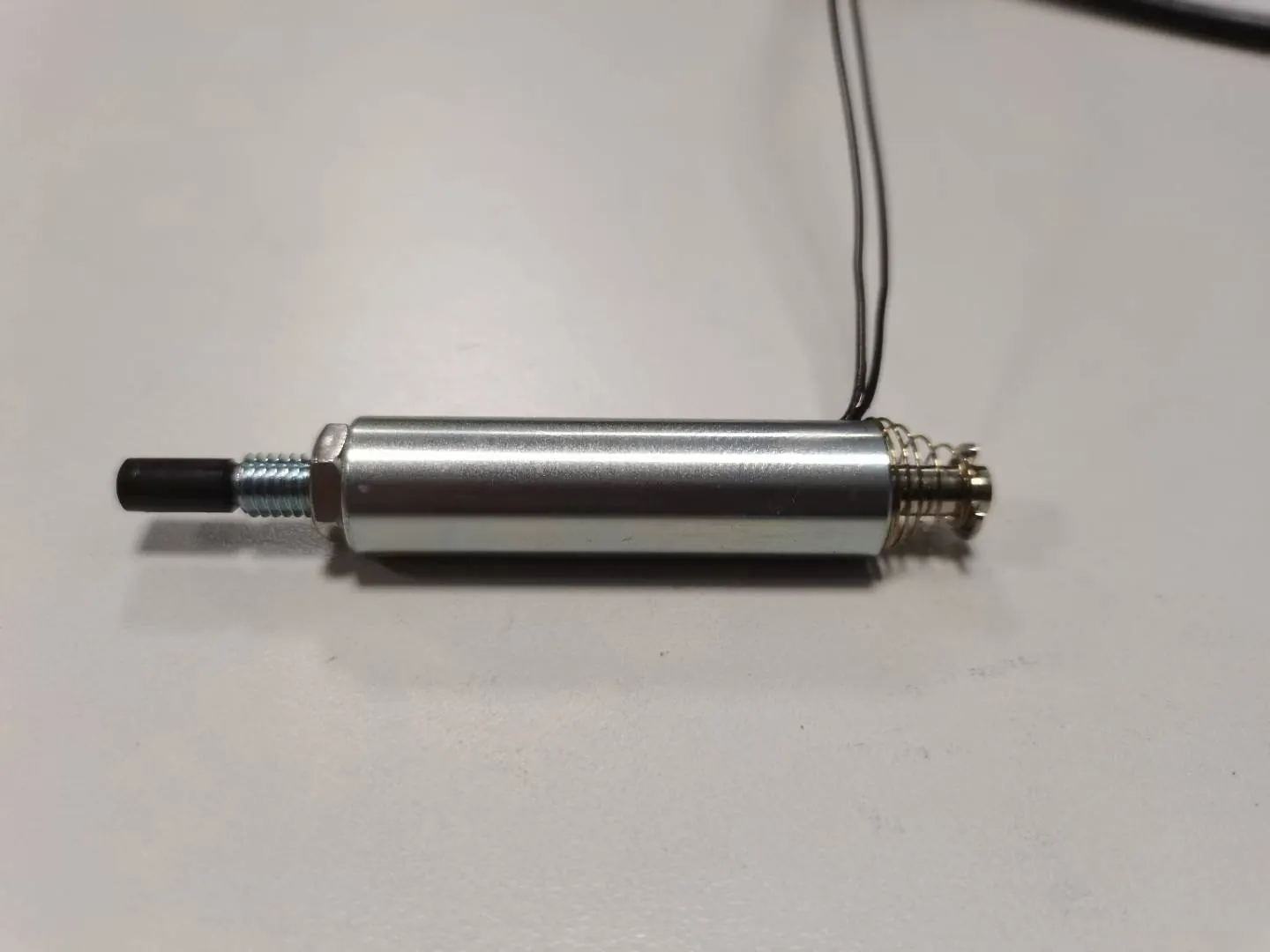
A DC linear solenoid only pulls its plunger in. The return spring brings it back once the current stops, and it decides where the mechanism rests when power is lost. So the spring sets the fail-safe position, the return speed, and a share of the force the coil must overcome on every stroke.
That makes it a design part, not an accessory. The same body with two different springs can behave like two different solenoids: one that returns briskly but struggles to pull in, and one that pulls in easily but hesitates on the way back. Most field complaints about either fault trace back to this one component.
What are the two limits on spring force?
The lower limit is set by the return. At the open end of travel the spring is at its weakest, and it still has to beat friction, any weight it lifts, and any pull from the mechanism. The upper limit is set by pull-in: at every point, spring plus load must stay under the coil force.
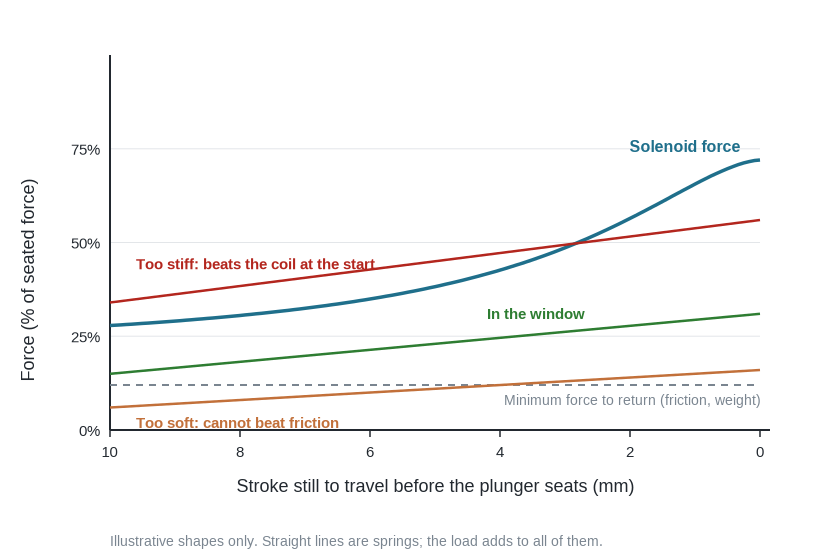
Both limits are tightest at the same place. At the open end the coil is at its weakest and the spring is at its weakest too. A spring that works there usually works everywhere else, because both forces rise toward the seated end. Check the whole stroke anyway: a stiff spring can overtake a flat-topped curve partway in.
How do you find the minimum spring force?
Add everything the spring must beat at the open end of travel. That means sliding friction of the plunger and the linkage, the weight of the plunger and load if the axis is vertical, and any force the mechanism applies. Then add margin, because friction grows with dirt and wear over the life of the machine.
Mounting direction changes this more than any other factor. With the plunger hanging down, gravity helps the return and the spring can be light. With it standing up, the spring must lift the plunger and whatever is attached. Test the return in the real orientation, not on the bench.
Look at the seated end as well. When the plunger closes metal to metal on the pole piece, the spring must also break any residual hold there. If the return is slow only at that end, the fixes for sticking and slow return faults start with a non-magnetic stop rather than a stiffer spring.
How do you check the spring against the force curve?
Draw the spring as a straight line on the solenoid’s force-stroke chart, add the load, and look for the smallest gap between that line and the curve. That gap is your pull-in margin. It is almost always smallest at the start of the stroke, where the coil is weakest and the plunger furthest from the pole piece.
A spring’s line is set by two numbers. The preload is its force at the open position. The rate is how much force it adds per millimeter of compression. Force at the seated end is the preload plus the rate times the stroke. As a round example, a 1.5N preload and 0.2N/mm rate over 10mm give 3.5N when seated.
Read the coil figure off the right curve. Use the one for your duty cycle, with a warm coil, at the working position. The guide to the coil’s weakest point on the curve shows where to read it. If the gap there is thin, a stiffer spring is not an option, whatever the return needs.
Why is a soft spring with preload often better?
Because it gives a flat line. A low-rate spring, compressed a little at assembly, delivers nearly the same force at both ends of the stroke. It can meet the return minimum at the open end without climbing steeply toward the seated end, where a stiff spring wastes force the coil could spend on the load.
A stiff spring with no preload does the opposite. It is weak at the open end, exactly where the return needs force, and strong at the seated end, where it does little useful work. That shape often fails both limits at once: slow to return at the start, and hard to pull in as the curve flattens.
Preload needs space: a longer, softer spring compressed at assembly takes more room along the shaft. That is one reason the spring is best settled with the body size, not added after. If the stroke is long, the fix is sometimes a lever that shortens it, which helps the coil and the spring together.
Internal or external return spring?
An internal spring sits inside the body, around or behind the plunger, and keeps the unit compact and protected. An external spring sits on the output shaft, where it is easy to inspect and change. Both work; the choice usually comes down to space, dirt and how often the force may need adjusting.
For a new design, an external spring makes the sample stage easier, because a different force can be tried on the machine in minutes. Some mechanisms need no solenoid spring at all, since a spring or cam already in the machine returns the plunger every cycle. In that case the machine’s own return force goes into the same sum.
How do heat and life change the spring?
Springs relax. Over many cycles, and faster near a hot coil, a spring loses some of its force, so a return that was brisk on day one can slow down months later. Size the minimum with margin for that loss, and keep the spring away from the hottest part of the body where you can.
Coil heat moves the other limit too, because a warm coil pulls weaker. A spring chosen on a cold bench can therefore stop pull-in on a hot machine, which is one of the checks for a solenoid that will not pull in. Check both limits at working temperature before approving a sample.
What should you send to get the spring right?
Send the stroke, the load and where it acts, the mounting direction, the fail-safe position you need, and how fast the return must be. A sketch of the linkage shows friction points and side loads. From those, the spring is sized with the coil rather than chosen afterward.
Return spring force is one of the parameters made to order, along with stroke, coil voltage and plunger end. Push-pull solenoids with spring return start from 50 pieces, and samples take about 10 to 12 days, so a second spring can be tried before production.
How we checked this
This guide draws on published engineering practice for DC linear solenoids and springs, and on what this factory builds: tubular and open frame bodies, push or pull action, spring return with the spring force made to order, 12V and 24V standard coils with other DC voltages wound to order. The chart shows curve shapes in percent of seated force and carries no ratings. The spring numbers are a round arithmetic example. We did not measure spring force, friction or pull-in margin for this article, so no figure here is a Lodegrip test result. Written 29 September 2026.
Push-pull solenoid return spring FAQ
Does a push-pull solenoid need a return spring?
Usually. The coil only pulls the plunger in, so something must bring it back. That can be the solenoid’s own spring, gravity on a hanging plunger, or a spring already in the machine, as long as it acts on every cycle.
What happens if the return spring is too strong?
The coil may not complete its stroke. The spring force is subtracted from the coil force at every point, and the gap is smallest at the start of travel, so a stiff spring shows up as a solenoid that hums or stops partway.
What happens if the return spring is too weak?
The plunger returns slowly or not at all, especially when the axis is vertical, the linkage has friction, or the plunger closes metal to metal at the seated end. A weak spring also gives a slower release in fast cycles.
Can I just cut or stretch the spring to change the force?
It changes the preload, but it also changes the rate and can shorten the spring’s life. Use it only to find the force you need during a trial, then have the right spring made for production.
Does the spring change the solenoid’s speed?
Yes, in both directions. A stronger spring slows pull-in, because it takes margin from the coil, and speeds up the return. A lighter spring does the opposite. Settle the return speed you need, then choose the lightest spring that meets it.
Can the return spring force be made to order?
Yes. Spring force is set with the coil, stroke and plunger end for each custom design. Send the load, stroke and mounting direction, and the sample is built with a spring sized for your mechanism.
Not sure where your spring should sit?
Tell us the stroke, the load, the mounting direction and how fast the plunger must return. Send the stroke, load and orientation and an engineer will size the spring and the coil together.
Foshan factory since 1992 · ISO 9001 certified factory · MOQ 50 pcs · samples in 10 to 12 days